 Pradnya Ganorkar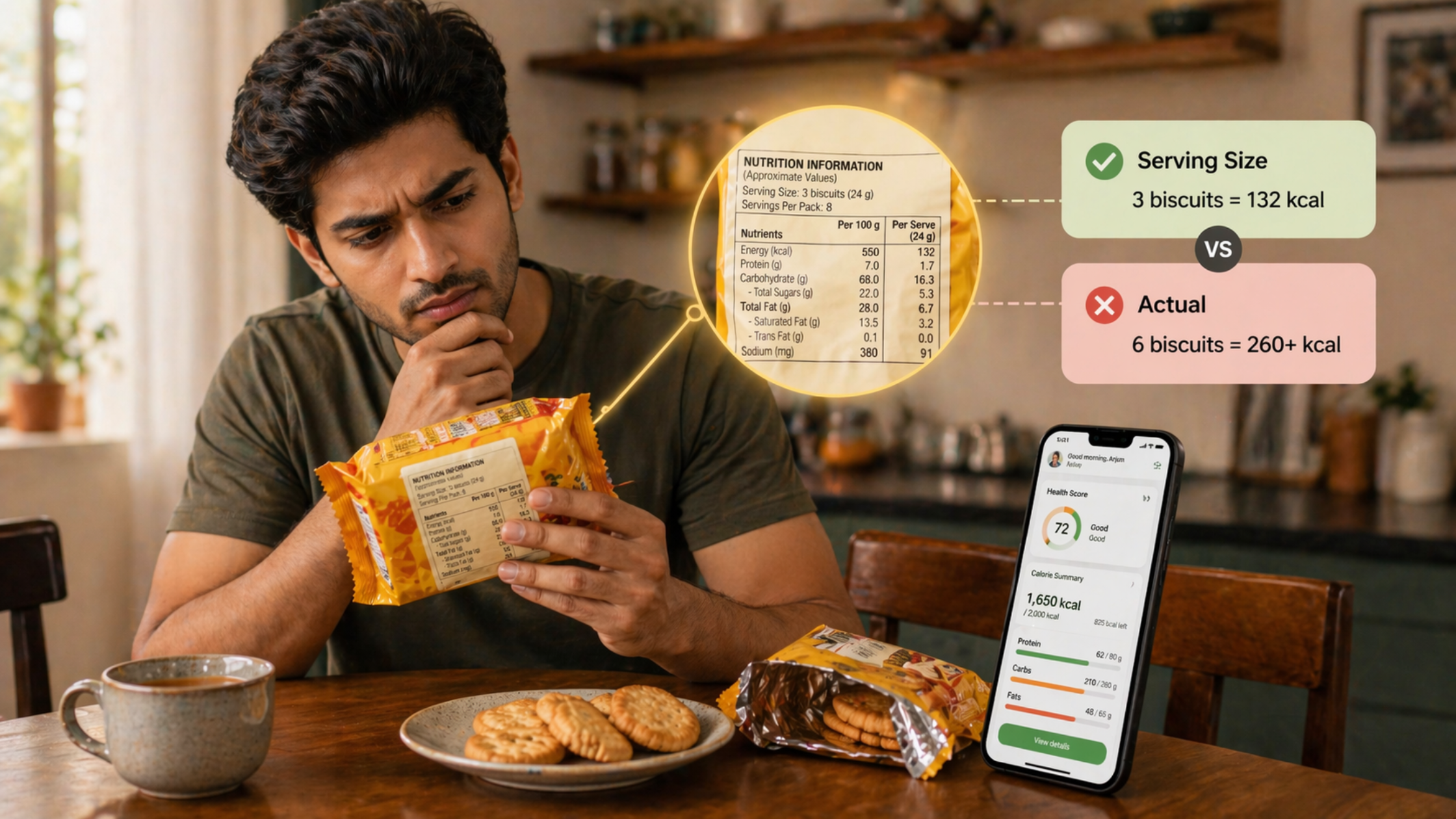
Reading packaged food nutrition labels in India requires understanding FSSAI-mandated label formats, which display nutrients per 100g or per serving. Key fields are Total Energy in kcal, Total Fat, Saturated Fat, Trans Fat, Total Carbohydrate, Sugars, Protein, and Sodium. The serving size listed is often much smaller than what people actually consume — a biscuit packet might list 3 biscuits as one serving when most people eat the whole row. The healthiest packaged foods in India have protein above 5g per 100g, sodium below 300mg per 100g, and total sugar below 5g per 100g. Nutrimate’s barcode scanner identifies packaged foods instantly and logs their complete nutrition, including data from the Open Food Facts India database.
The Serving Size Trap — The Number One Mistake Indians Make on Food Labels
The first number to look at on any Indian packaged food label is not the calories — it is the serving size. Every nutrition figure on the label is calculated per serving. And the serving size listed is almost always far smaller than what you actually eat.
A classic example is Britannia Marie biscuits. The label lists one serving as 3 biscuits, approximately 33 grams. Most people eating Marie biscuits with chai eat 5 to 6 biscuits, not 3. At 132 calories per serving, the actual consumption is closer to 220 to 264 calories — not the 132 the label suggests at first glance.
This gap between stated serving size and actual consumption is one of the biggest sources of calorie tracking error for Indian consumers. Before reading any other number on the label, convert the serving size to what you actually eat, and multiply every nutrient accordingly.
Understanding What Each Nutrient Means on the Indian Label
FSSAI — the Food Safety and Standards Authority of India — mandates specific nutrition labelling for packaged foods. The label must show Total Energy in kilocalories, which is your calorie count. Total Fat includes all fats — saturated, unsaturated, and trans fats. Saturated fat and trans fat are listed separately because they are the types associated with cardiovascular risk.
Total Carbohydrate includes all carbs — sugars and complex carbs together. Sugars are listed as a sub-category of total carbohydrates. Protein is listed as a total. Sodium is listed in milligrams — not salt. To convert sodium to salt, multiply by 2.5. A product with 400mg sodium per 100g contains approximately 1 gram of salt per 100g.
Some labels also show Dietary Fibre, Cholesterol, and specific vitamins and minerals. These are not mandatory under FSSAI for most categories but are increasingly common on health-positioned products.
How to Spot a Genuinely Healthy Packaged Food vs a Disguised Junk Food
The Indian packaged food market is full of products positioned as healthy that are nutritionally poor. Multigrain biscuits, oats cookies, and fruit-based snack bars are frequently marketed with health claims while containing more sugar than a standard biscuit.
The three numbers that reveal the truth about any packaged Indian food are sugar content, sodium content, and protein content. A product with more than 15 grams of sugar per 100 grams should be treated as a sweet, regardless of what the packaging says. A product with more than 800 milligrams of sodium per 100 grams is high salt, regardless of how it is described.
Protein content is the best indicator of nutritional density in a processed food. Most biscuits, namkeen, and packaged snacks contain 5 to 7 grams of protein per 100 grams. A genuinely protein-rich packaged food — like some brands of roasted chana or protein bars — contains 15 to 25 grams per 100 grams.
Common Indian Packaged Foods — What the Label Actually Shows
Maggi 2-Minute Noodles: 350 calories per 70g serving. But the serving is one block of noodles without the masala — most people add butter, vegetables, and extra masala, adding 100 to 150 calories. Sodium per serving is approximately 750mg — one-third of the daily recommended limit in a single meal.
Parle-G Biscuits: 130 calories per 37.5g serving (approximately 7 biscuits). Protein is only 2.8 grams per serving. Sugar is 12 grams. Most Indians consume these with chai across 2 to 3 sittings per day, accumulating 300 to 500 calories from biscuits alone without realising it.
Lay’s Classic Salted Chips: 525 calories per 100g. 33.6g of fat. No meaningful protein. A small 26g packet contains 137 calories — reasonable for a snack, but easy to consume two or three packets in one sitting.
How Nutrimate Handles Packaged Food Tracking for Indian Consumers
Nutrimate’s barcode scanner and Indian packaged food database eliminates the need to manually decode nutrition labels. Scan the barcode, confirm the serving size you actually ate, and the nutrition is logged automatically. The database includes data from both FSSAI-registered products and the Open Food Facts India database, covering thousands of common Indian packaged brands.
For products not yet in the database, Nutrimate allows manual entry from the label — enter the values per 100g and specify the quantity consumed. The system scales the nutrition data to the exact amount you ate. Over time, as more Indian users scan and log packaged foods, the database grows automatically, making every user’s logging more accurate.
Scan any packaged food barcode and track nutrition instantly with Nutrimate. Free on Android and iOS — nutrimate.in